Categories
Past Exhibitions

Prelude: An Introduction to the Permanent Collection

On view October 20, 2022 through March 13, 2025

Jake Troyli (American, b. 1990), Stalemate, 2023. Oil on canvas. 48 x 36 inches. Tampa Museum of Art, Museum purchase, 2023.240.
Jake Troyli (American, b. 1990), Stalemate, 2023. Oil on canvas. 48 x 36 inches.
Tampa Museum of Art, Museum purchase, 2023.240.

Prelude: An Introduction to the Permanent Collection presents the Tampa Museum of Art’s main collecting areas in ancient, modern, and contemporary art. The exhibition features artworks exploring themes of site, power, and the body in ancient vessels, tools, and jewelry, as well as sculptures, painting, and photography. Viewed together in dialogue with each other, the objects speak to shared experiences across time and place. An ongoing exhibition, Prelude includes both familiar works and recent additions to the permanent collection.

Categories
Student Exhibitions

Southwest Florida AIDS Memorial Quilts Presented by CAN Community Health

December 1 – 3, 2022

AIDS Memorial Quilt

The AIDS Memorial Quilt is a powerful visual reminder of the AIDS pandemic. It is considered the largest community arts project in the world. Under the stewardship of the National AIDS Memorial, it has surpassed 50,000 individually sewn panels with more than 110,000 names stitched into its 54 tons of fabric.

The AIDS Memorial Quilt’s founder, Cleve Jones, chose 3-by-6-foot memorial panels the size of a grave so people could visualize 111,000 bodies.

The selection of twenty quilts on exhibition at the Tampa Museum of Art to commemorate World AIDS Day on December 1 is presented by CAN Community Health. The quilts on view were created for the Southwest Florida Community AIDS Quilt Project, which began in 1994 when several HIV+ men wanted to memorialize the friends and loved ones they had lost. Done in the same manner as The NAMES Project (the National AIDS Memorial Quilt), they started creating panels with the names of those in the Sarasota-Bradenton area who had succumbed to HIV/AIDS.

Learn more about the history of the AIDS Memorial Quilts now housed by CAN Community Health.

Presented by

CAN Community Health
Categories
Current Exhibitions

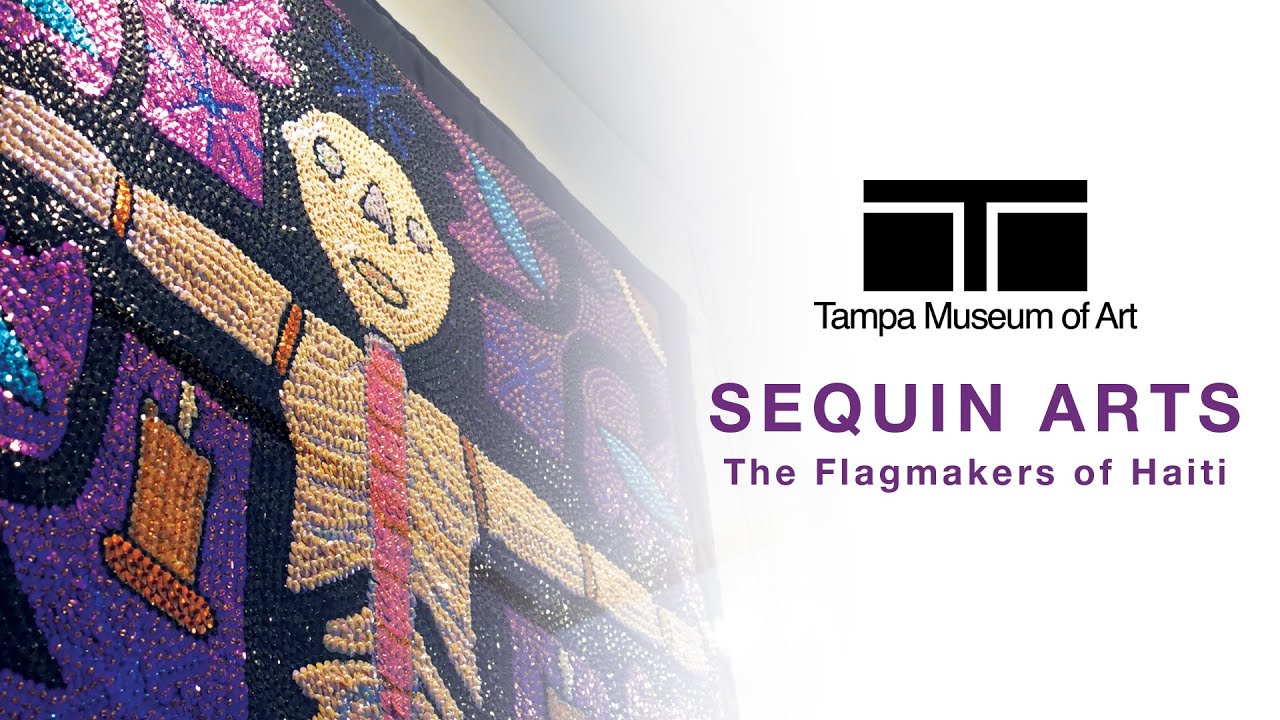
Sequin Arts: The Flagmakers of Haiti

On view now

Ronald Gouin (Haitian), "Erzulie and Dambalah", 1990s. Beads and sequins, black back on acrylic cloth. 33 x 31 inches. Tampa Museum of Art, Gift of Ed Gessen, 2023.034
Ronald Gouin (Haitian), Erzulie and Dambalah, 1990s. Beads and sequins, black back on acrylic cloth. 33 x 31 inches. Tampa Museum of Art, Gift of Ed Gessen, 2023.034
Edgar Jean-Louis (Haitian, 1921-2010), "Erzulie Freida-Mattrisse", 1980s. Sequins, beads, and faux pearls on fabric. 31 x 28 ½ inches. Tampa Museum of Art, Gift of Ed Gessen, 2023.013
Edgar Jean-Louis (Haitian, 1921-2010), Erzulie Freida-Mattrisse, 1980s. Sequins, beads, and faux pearls on fabric. 31 x 28 ½ inches. Tampa Museum of Art, Gift of Ed Gessen, 2023.013
Detail of Ronald Gouin (Haitian), "Erzulie and Dambalah", 1990s. Beads and sequins, black back on acrylic cloth. 33 x 31 inches. Tampa Museum of Art, Gift of Ed Gessen, 2023.034
Detail of Ronald Gouin (Haitian), Erzulie and Dambalah, 1990s. Beads and sequins, black back on acrylic cloth. 33 x 31 inches. Tampa Museum of Art, Gift of Ed Gessen, 2023.034
Georges Valris (Haitian, b. 1953), "Erzulie Danthor", 1980-1990. Sequins and beads on cloth. 43 x 32 ½ inches. Tampa Museum of Art, Gift of Ed Gessen, 2023.017
Georges Valris (Haitian, b. 1953), Erzulie Danthor, 1980-1990. Sequins and beads on cloth. 43 x 32 ½ inches. Tampa Museum of Art, Gift of Ed Gessen, 2023.017

The Tampa Museum of Art’s permanent collection includes one of the largest collections of drapo vodou (Haitian vodou flags) in the Southeast. These newly acquired works, largely gifted by the Gessen Collection, will remain on view for an extended display with new rotations focused on various themes and artists associated with drapo vodou. The inaugural display will survey the first, second, and third generations of flagmakers and the evolution of the genre from ritual art to high art. Artists featured in this selection include Clotaire Bazile, Myrlande Constant, Silva Joseph, Edgar Jean-Louis, Antoine Oleyant, Yves Telemak, George Valris, and others.

Drapo Vodou, or ritual flags, are the most celebrated of Haiti’s sacred arts. The flags reflect the creative inclusivity of Vodou, which combines and juxtaposes African symbols with those of Europe and the Americas to form a mosaic of ritual art. The flags are made of sequins, beads, golden ribbons, and ropes, among other things, which are hand-sewn onto various types of fabric, from simple burlap to velvet and satin. Due to the embargo, flags created in the 1990s were often made with hand-dyed, even hand-made, sequins. Each flag features approximately 2,000 to 20,000 sequins and beads, hand-stitched by artists trained in the tradition of drapo Vodou. First-generation artists such as Clotaire Bazile, Silva Joseph, and Edgar Jean-Louis exemplify the traditional format and design of the flagmakers working in the Bel-Air neighborhood of Port-au-Prince. Second-generation artists, including Joseph Oldof Pierre, Yves Telemaque, Georges Valris, and Vil Odelesse, inherited the craftsmanship of the first generation and created new interpretations of Vodou flags. 

Vodou flags traditionally feature a central image with a geometric border. The imagery ranges from depictions of lwas (Vodou gods) or veves (symbols of the gods). The bead and sequin colors selected are typically associated with the god featured on the flag. In some flags, the syncretization of Catholicism and Vodou is evident, and the flagmaker has incorporated a chromolithograph, a paper image of a saint’s face, hands, or feet, into the textile. The flags in this selection feature several of the major lwas (or deities) present in the Vodou pantheon, including St. Jacques, Erzulie, Gran Bois, Baron, and Papa Zaka.  

The Tampa Museum of Art started collecting Haitian objects over twenty years ago but began acquiring in earnest in 2019 after receiving a gift of twenty-one flags by collectors Ed and Ann Gessen. To date, the collection includes 135 Haitian flags and represents one of the largest collections of drapo Vodou in the U.S. Over the next two years, the Tampa Museum of Art will present highlights from these holdings in this space. This inaugural display introduces the artists and motifs unique to Haiti’s sequin arts. This rotation of flags focuses on depictions of Erzulie Freida, the Goddess of Love, Beauty, Femininity, and Fertility, and Erzulie Danthor, the fierce protector of children, women, and vulnerable people.

YouTube player

Previously on display

Textiles, such as the Vodou flags, are sensitive to light. As part of the care and conservation for these objects, the flags are changed out every six months. Come back to the Tampa Museum of Art to view new Vodou flags from the permanent collection!

Edgar Jean-Louis (Haitian 1921-2010), "Agoue", c. 1980s. Sequins, beads, and faux pearls on cloth. 29 3/4 x 29 inches, Tampa Museum of Art, Gift of Ed and Ann Gessen, 2019.022.
Edgar Jean-Louis (Haitian 1921-2010), Agoue, c. 1980s. Sequins, beads, and faux pearls on cloth. 29 3/4 x 29 inches, Tampa Museum of Art, Gift of Ed and Ann Gessen, 2019.022.

Edgar Jean-Louis learned the art of drapo Vodou from Silva Joseph. A respected artist and houngan, or local priest, Jean-Louis’ craftsmanship reflects the artistry and expertise of the Bel-Air flagmakers, a neighborhood in Port-au-Prince. He became known for the exceptional detail in his work. An influential Bel-Air artist, Jean-Louis mentored new generations of flagmakers until his death in 2010.  

Agoue is the Lwa, or God, of the Sea and Water, as well as the patron of sailors and fishermen. He is married to La Sirene and they are often depicted together. As the God of the Sea, Agoue is associated with the colors green, blue, and white. Fish frequently appear in flags dedicated to him.

Categories
Current Exhibitions

Jacob Hashimoto: This Particle of Dust

On view December 2022 through 2025

YouTube player
Artist Jacob Hashimoto speaks about his artwork on view now at the Tampa Museum of Art.

The artist takes inspiration from cloud formations and the cosmos, with each navy blue kite featuring star-like markings. Depending on the time of day and the natural light filtering through the atrium skylights, the kites will shift in color intensity. This Particle of Dust explores the visual poetics of light and dark, color and form, as well as space and architecture.

Created from over 2,500 handmade kites, This Particle of Dust is a site-specific installation and unique to the Tampa Museum of Art’s architecture. The installation represents Jacob Hashimoto’s exploration of abstract landscape and his interest in blurring the boundaries between painting and sculpture. This Particle of Dust evokes the experience of observing the night sky through various cloud clusters. Thousands of transparent and opaque white discs hang suspended from a bespoke armature. Navy blue kites, imprinted with white and cerulean blue star patterns, hang amidst the cloud shapes and catch the light as the sun rises over the Museum and dips into the horizon over the Hillsborough River. Depending on one’s vantage point, either from the lobby, stairwell, or galleries, the experience of This Particle of Dust shifts—from below the cloudscape appears to drift into the sky while at eye-level the viewer looks directly into the stars.  

Hashimoto began making kite sculptures twenty-years ago while an art student in Chicago. Inspired by traditional Chinese kite making in the city of Weifang, where the artform of sculptural dragon kites originated, Hashimoto has made hundreds of thousands of kites from Japanese paper and resin. He appreciates kites as a universal object of joy that is recognized across the globe. Transformed into monumental artworks, Hashimoto’s kites convey happiness, wonder, and serenity. 

Jacob Hashimoto (American, b. 1973), "This Particle of Dust", 2022. Resin, bamboo, screenprints, paper, acrylic, and Dacron. Courtesy of the artist. Photography by Paige Boscia
Jacob Hashimoto (American, b. 1973), This Particle of Dust, 2022. Resin, bamboo, screenprints, paper, acrylic, and Dacron. Courtesy of the artist. Photography by Paige Boscia
Jacob Hashimoto (American, b. 1973), Detail, "In the Heart of this Infinite Particle of Galactic Dust", 2019. Site specific installation at Willis Tower, Chicago, Illinois. Resin, bamboo, UV prints, and stainless steel. Dimensions variable. Image courtesy of the artist. Photographer: Ed Knigge.
Jacob Hashimoto (American, b. 1973), Detail, In the Heart of this Infinite Particle of Galactic Dust, 2019. Site specific installation at Willis Tower, Chicago, Illinois. Resin, bamboo, UV prints, and stainless steel. Dimensions variable. Image courtesy of the artist. Photographer: Ed Knigge.
Categories
Past Exhibitions

Salman Toor: No Ordinary Love

On view February 23, 2023 through June 4, 2023

Salman Toor (Pakastani, b. 1983), "Three Friends in a Cab", 2021. Oil on panel. 16 x 20 inches. © Salman Toor; Courtesy of the artist and Luhring Augustine, New York. Photo: Farzad Owrang.
Salman Toor (Pakastani, b. 1983), Three Friends in a Cab, 2021. Oil on panel. 16 x 20 inches. © Salman Toor; Courtesy of the artist and Luhring Augustine, New York. Photo: Farzad Owrang.

Salman Toor: No Ordinary Love features more than 45 paintings and works on paper made between 2019 and 2022, that weave together motifs found in historical paintings with recognizable 21st-century moments to create new worlds based in Toor’s imagination. The exhibition captures the ways in which Toor engages with art history to center brown, queer figures and to challenge enshrined notions of power and sexuality.  

Toor (Pakistani, b. 1983) lives and works in New York City, but grew up in Lahore, his birthplace in Pakistan. Shaped by these viewpoints, Toor’s artistic practice explores his hopes and anxieties about the queer experience in both his ancestral and adopted countries. Throughout his work, Toor blurs sensual pleasure with satire and mines his deep knowledge of the European, American, and South Asian painterly tradition. 

This exhibition is organized by the Baltimore Museum of Art

Presenting Sponsor of No Ordinary Love: Life On Canvas

Salman Toor, "Construction Men", 2021. Oil on canvas. 60 x 48 inches. The artist and Luhring Augustine, New York.
Salman Toor (Pakistani, b. 1983) Construction Men, 2021. Oil on canvas. 60 x 48 inches. © Salman Toor; Courtesy of the artist and Luhring Augustine, New York. Photo: Farzad Owrang.
Salman Toor Salman Toor (Pakistani, b. 1983), "Thunderstorm", 2021. Oil on panel. 30 x 24 inches. © Salman Toor; Courtesy of the artist and Luhring Augustine, New York. Photo: Farzad Owrang.
Salman Toor Salman Toor (Pakistani, b. 1983), Thunderstorm, 2021. Oil on panel. 30 x 24 inches. © Salman Toor; Courtesy of the artist and Luhring Augustine, New York. Photo: Farzad Owrang.

About Salman Toor

Salman Toor (born in Lahore, Pakistan, in 1983) currently lives and works in New York. His first institutional solo exhibition, Salman Toor: How Will I Know, was recently presented at the Whitney Museum of American Art, New York, NY (2020-2021). Toor’s work has been featured in numerous group exhibitions and projects, including Living Histories: Queer Views and Old Masters at Frick Madison, New York, NY, and others held at the RISD Museum, Providence, RI; the Public Art Fund, New York, NY; Phi Foundation for Contemporary Art, Montréal, Canada; Museum of Contemporary Art Chicago, IL; Lahore Biennale 2018, Pakistan; and the 2016 Kochi-Muziris Biennale, India. Toor is the recipient of a Joan Mitchell Foundation Grant, and his work is in many public collections. Toor’s work will be presented in the forthcoming Lyon Biennial, and his first solo exhibition in China opened at M Woods in Beijing.

Learn more about the artist.

Categories
Centennial Campaign News

Tampa Museum of Art Receives Botero Sculpture and $1 Million Gift from Jorge M. Perez

Fernando Botero (Colombian), Mujer Vestida, 1997, bronze, 126 x 62 x 62 inches.

Tampa, FL (November 17, 2022) – The Tampa Museum of Art announced today that philanthropist and art collector Jorge M. Pérez bestowed a monumental sculpture by Colombian artist Fernando Botero and a $1 million cash gift to the Museum.

“We’re beyond delighted to receive this remarkable opportunity to further the Tampa Museum of Art’s commitment to collecting and exhibiting artwork that represents the cultural tapestry of our Tampa Bay region,” said Michael Tomor, Ph.D., the Penny and Jeff Vinik Executive Director of the Tampa Museum of Art. “We share Mr. Pérez’s commitment to building better cities and a better Florida, and the gift of art and $1 million donation will help the Museum continue to build art education and exhibition programming that is accessible to all community members.”

The towering bronze sculpture titled Mujer Vestida (Dressed Woman) formed part of the corporate collection of Pérez’s real estate development company, Related Group, and was most recently on view at the Ritz-Carlton Residences on Bayshore Boulevard in Tampa. Botero’s Mujer Vestida is a significant gift to the Tampa Museum of Art’s permanent collection, not only because of its importance as a work by a modern master, but because it continues growing TMA’s sculpture collection which also includes notable works by Jaume Plensa and Patricia Cronin and Latin American artist collection, which includes works by Oswaldo Vigas, José Bedia Valdés, Rufino Tamayo, Diego Rivera and Milhaud Vik Muñiz.

“Art is at the heart of any great city,” said Jorge M. Perez. “I’ve been fortunate to see the impact public art installations have on communities first hand, which is why we incorporate museum-quality art into every single one of our projects while also supporting local cultural organizations. This commitment stands true in Tampa Bay, especially as the Related team continues to deepen its involvement in the region. We look forward to working with the museum team to further enrich Tampa’s arts and culture ecosystem.”

Joanna Robotham, Curator of Modern and Contemporary Art at the Tampa Museum of Art, said, “we’re so thrilled that the Botero sculpture will have a permanent home in Tampa. We couldn’t be more grateful for this very generous gift.”

Perez’s $1 million gift accompanying the Botero donation supports new and growing exhibition and studio art programming at the Museum that results from its Centennial Renovation and Expansion. Last week, the Museum premiered the first of several brand-new exhibition galleries with the exhibition Time for Change: Art and Social Unrest in the Jorge M. Pérez Collection.

This week, the Museum opened its brand-new west lobby, Harrod Family Museum Store, and the entrance to its new first-floor gallery. Earlier this year, the Museum opened the new Vinik Family Education Center. With these improvements in place, the Museum anticipates quadrupling the number of students it serves per year, and the school tour program alone can grow from 6,000 to 24,000 students each year.  

Jorge M. Pérez

Jorge Pérez, Chairman and Chief Executive Officer of Related Group, remains committed to building a better Florida, spearheading the state’s complex urban evolution for over 40 years. Starting out in Miami’s public housing market, Pérez’s passion for creating vibrant, urban communities has made him a trendsetter, often the first developer to enter undiscovered neighborhoods.

In addition to real estate development, Pérez is devoted to supporting arts and culture initiatives across the nation, as well as nurturing the artists and curators of the future. Thus, in 2019, Pérez established El Espacio 23, a 28,000-square-foot contemporary art space offering the general public, artists and curators access to a variety of exhibitions and residencies drawn from the world-renowned Jorge M. Pérez Contemporary Art Collection.

Fernando Botero and Mujer Vestida

The towering Mujer Vestida is one of Fernando Botero’s widely exhibited bronze sculptures. The masterpiece, gifted to the Tampa Museum of Art from the Related Group’s corporate collection, has been shown in major cities worldwide. An earlier version of this same piece was donated by Botero to the city of Medellín, Colombia on permanent view in the Plaza Botero. Despite its monumental scale, often associated only with commemorative statues, Botero has the innate ability to humanize his subjects rather than aggrandize them. As is the case with most of his sculptures, the figures are anonymous. Mujer Vestida is elegantly dressed and created in his signature witty and opulent style, meant to represent a specific type of woman rather than an individual.

Fernando Botero is one of the leading figures of art from Latin America and his distinctive style is instantly recognizable. His paintings, sculptures and drawings are exhibited and represented in museum collections throughout the world. Botero became interested in painting at an early age and began as an illustrator for Medellín’s local newspaper. He left Colombia for Europe in the 1950s and settled in New York in the 1960s where he experimented with gestural painting but instead chose to solidify what later became known as his signature, namely, smooth and inflated shapes and figures. His exaggerated compositions go beyond an aesthetic choice and can be political, ironic, and even humorous.

###

Categories
Past Exhibitions

Time for Change: Art and Social Unrest in the Jorge M. Pérez Collection

On view November 10, 2022 through August 27, 2023

Barthélémy Toguo (Cameroonian, b. 1967), Road to Exile, 2018. Wooden boat, cloth bundles, glass bottles, and plastic containers. 120 x 60 x 45 inches. Jorge M. Pérez Collection, Miami. Installation at the Tampa Museum of Art.

Time for Change: Art and Social Unrest in the Jorge M. Pérez Collection looks at how artists explore conflicts and contradictions of contemporary society, as well as analyze historical events and reframes them within the present. An interest in the marginalized, the marginal and the margins (of society, of history) unites the works in the exhibition. Time for Change was first presented as the inaugural exhibition in December 2019 at El Espacio 23, a contemporary art space founded by collector and philanthropist Jorge M. Pérez. Featuring artists from across the globe, the exhibition highlights art—from painting and sculpture to video and works on paper—that address unrest through allegory, metaphor or veiled allusion.​ 

Time for Change: Art and Social Unrest in the Jorge M. Pérez Collection was curated by José Roca for El Espacio 23.

Exhibition Sponsor: Gobioff Foundation

Gobioff Foundation

Press

Categories
Past Exhibitions

Travels in Italy: a 19th-Century Journey through Photography

On view January 28, 2023 through July 16, 2023

Francis Frith (British, 1822–1898), "The Pantheon", from the album "Rome Photographed", ca. 1873. Albumen silver print. 6 3/4 x 9 3/8 in. Publisher: William MacKenzie, Paternoster Row. London, Glasgow & Edinburg. Gift of Mr. and Mrs. William Knight Zewadski. 1989.109.057.f
Francis Frith (British, 1822-1898), The Pantheon, from the album Rome Photographed, ca. 1873. Albumen silver print. 6 3/4 x 9 3/8 in. Publisher: William MacKenzie, Paternostor Row. London, Glasglow & Edinburg. Gift of Mr. and Mrs. William Knight Zewadski. 1989.109.057.f

Travel in the 19th century was difficult, expensive and time-consuming. Prior to the discovery of a way to record an image by photography in 1839, the majority of Americans had only stories and the possibility of access to drawings, paintings, and etchings to illustrate the wonders of exotic lands overseas. Early photographers quickly realized that there was a demand for images of foreign lands and famous antiquities.

Travels In Italy will feature vintage photographs from the TMA’s collection of some of Italy’s most popular cultural draws like The Pantheon in Rome, the canals of Venice, and the Leaning Tower of Pisa, as well as lesser known treasures such as the Piazza del Duomo in Milan and Genoa’s Interior Gallery of the Camposanta. Included will be some of the best-known names in 19th-century travel photography including Giorgio Sommer, Francis Frith, Robert Macpherson, and the Alinari studio.

Supporting Sponsor

Frank E. Duckwall Foundation - Making Tampa Bay a Better Place
Categories
News

“Time for Change” Opens as Tampa Museum of Art Debuts Newly Expanded Gallery Spaces

Umar Rashid (Frohawk Two Feathers) (American, b. 1976), The Palace of Quilombos, Gonalves 1793, 2015. Acrylic and ink on canvas. 72 x 84 inches. Jorge M. Pérez Collection, Miami.

Tampa, FL – The inaugural exhibition that opened Miami’s contemporary art space, El Espacio 23, will now also premiere the first of many newly expanded gallery spaces at the Tampa Museum of Art.

Time for Change: Art and Social Unrest in the Jorge M. Pérez Collection, on view November 10 through March 12, 2023, looks at how artists explore conflicts and contradictions of contemporary society, as well as analyzes historical events and reframes them within the present. An interest in the marginalized, the marginal and the margins (of society, of history) unites the works in the exhibition. 

“We’re thrilled to partner with philanthropist and collector Jorge M. Pérez and El Espacio 23 to bring this thought-provoking collection of significant contemporary works to Tampa Bay,” said Michael Tomor, the Penny and Jeff Vinik Executive Director of the Tampa Museum of Art. Tomor added, “Time for Change is a fitting start to a new era of expanded exhibition programming at the Museum. We’re eager to welcome the community into our new galleries and begin offering more year-round opportunities to experience and learn from works that reflect our region’s vibrant community.”

In 2021, the Tampa Museum of Art announced it was embarking on its $100 million Centennial Renovation and Expansion. The opening of Time for Change coincides with the completion of the ambitious renovation portion of the project to increase exhibition space and education facilities within the footprint of the existing building, which first opened in 2010 and was designed by San Francisco architect Stanley Saitowitz.

The reimagining of the existing Museum spaces was led by New York-based WEISS/MANFREDI Architecture/Landscape/Urbanism. As a result of the renovation, the Museum opened the new Vinik Family Education Center in May of this year and increased its exhibition and collection space from 14,800 to more than 43,000 square feet. Time for Change is the first of several back-to-back exhibition openings in the brand-new galleries between now and February 2023.

Envisioned by Colombian curator José Roca, Founder and Director of FLORA ars+natura, Bogotá in collaboration with Pérez Collection stewards Patricia M. Hanna and Anelys Álvarez, Time for Change features 60 artworks by 57 artists from around the world. The exhibition highlights art—from painting and sculpture to video and works on paper—that addresses unrest through allegory, metaphor or veiled allusion.

Time for Change is structured around themes, or “nuclei,” which organically establish dialogue and correlations amongst the pieces, yet are not necessarily contained by an argument. The themes of the exhibition are grouped into six categories that examine a variety of voices.

  1. Entangled Histories features works by Yinka Shonibare CBE, Doris Salcedo, Fernando Bryce, Walker Evans, Ai Weiwei, and Sandra Gamarra proposing essential questions: How do we remember as a society? Who is forgotten by history, and for what reasons? How is a traumatic event inscribed in the (social) body?
  2. Extraction and flows examines displacement of peoples, as well as the exploitative justifications behind forced expatriation and includes a monumental installations by Barthelemy Toguo along alongside works by David Goldblatt, Alfredo Jaar, Marisol, and Eduoard Duval Carrie, among others.
  3. Artivism: art in the social sphere includes works by Robert Longo, Camilo Restrepo, Rafael Lozano Hemmer, Esterio Segura, Glenda Leon and many others, focuses on political unrest and public protest on the streets, an essential expression of democracy which has been diminished in our reduced public sphere. 
  4. State Terror includes two large scale pieces by Carlos Garaicoa and Alejandro Campins in addition to works by Ed Ruscha, Reynier Levya Novo, Umar Rashid, Gonzalo Fuenmayor alongside other artists, and signals how, in a world of real-time generalized surveillance, protest is countered with repression and violence.
  5. Spatial Politics reflects on social control through spatial segregation, examining modern architecture and its role in creating segregated communities—structures to house the “undesirable,” namely immigrants, people of other races, classes and nationalities and includes works by artists such as Teresa Burga, Rene Francisco Rodriguez, Mikhael Subotzky, Julian Opie, and Samuel Levi Jones.
  6. Emancipatory Calls summons viewers to reclaim the beauty of our differences, understanding that a more just society can only be built on respect for one’s right to be different. Highlights from this section include Rashid Johnson, Christopher Myers, Kara Walker, Firelei Baez and Ana Maria Devis.

###

Categories
Centennial Campaign News

Tampa Museum of Art Announces Acquisition of New Haitian Art Collection and Accompanying $1,000,000 Gift

Andre Pierre (Haitian, b. 1914), Erzulie, 1973. Oil on canvas. 37 x 26 inches. Tampa Museum of Art, Gift of the Arthur Albrecht Revocable Trust.

TAMPA, Fla. (October 18, 2022) – The Tampa Museum of Art announced today that it has closed on a gift of 88 pieces of Haitian art and a $1 million gift in support of the collection.

The paintings, sculptures, and framed maps, along with the cash gift, were bequeathed to the Tampa Museum of Art by the Arthur R. Albrecht Revocable Trust. Albrecht was a devoted collector of Haitian art and was also active in philanthropy on behalf of the country.

“Florida is home to one of the largest Haitian diaspora communities in the world, and we are thrilled to make this distinctive collection available to our visitors,” said Michael Tomor, Ph.D., the Penny and Jeff Vinik Executive Director at the Tampa Museum of Art. “Mr. Albrecht built a superb collection surveying the rich cultural themes, landscapes, and communities on the island, and this exhibit will add to the increasingly global and dynamic exhibitions we have available for viewing.”

The Albrecht Collection includes artworks from Haiti’s most prominent painters, including Rigaud Benoit, Wilson Bigaud, Prefete Duffaut, and Philome Obin. The paintings, rarely seen by the public until now, present an overview of the major developments in Haitian painting from the 1960s-80s. The holdings of the Albrecht Collection further augment the Tampa Museum of Art’s collection of Haitian art which includes one of the largest American museum collections of drapo vodou or Haitian vodou flags.

The $1 million gift accompanying the collection complements ongoing fundraising efforts by the Museum’s Centennial Campaign for Renovation and Expansion. The Museum recently completed renovations of the Vinik Family Education Center, growing the education space from 1,400 to 8,000 square feet, including four classrooms, a lobby, orientation spaces, and a secure entrance. With these improvements in place, the Museum anticipates quadrupling the number of students it serves per year, and the school tour program alone can grow from 6,000 to 24,000 students each year.  

In 2021, the Museum announced it was embarking on its $100 million+ Centennial Renovation and Expansion to expand the Museum’s gross area from 69,000 to 125,000 sq. ft. New galleries are scheduled to open beginning in November 2022, and the groundbreaking for the expansion portion of the project is expected to take place next year.  

Future programming at the Tampa Museum of Art for the Albrecht Collection includes a dedicated exhibition in spring 2024. The exhibition will provide a springboard for educational and scholarly opportunities, including collaborations with universities on Florida’s west coast and Miami, as well lectures and symposia with renowned artists and scholars of Haitian art and the Diaspora. A publication with today’s foremost Haitian artists and writers will accompany the exhibition and related programming.

Prefete Duffaut (Haitian, 1923-2012), Magician, c. mid. 1960s. Oil on Masonite. 46 x 24 inches. Tampa Museum of Art, Gift of the Arthur Albrecht Revocable Trust.
Rigaud Benoit (Haitian, 1911-1986), Les Oiseaux, 1973. Oil on Masonite painting. 37 x 25 inches. Tampa Museum of Art, Gift of the Arthur Albrecht Revocable Trust
Philome Obin (Haitian, 1892-1986), Revolutionary Leaders, late 1960s. Oil on Masonite. 16 x 20 inches. Tampa Museum of Art, Gift of the Arthur Albrecht Revocable Trust.
Wilson Bigaud (Haitian, 1931-2010), Wedding Scene, 1973. Oil on Masonite. 24 x 24 inches. Tampa Museum of Art, Gift of the Arthur Albrecht Revocable Trust.

###